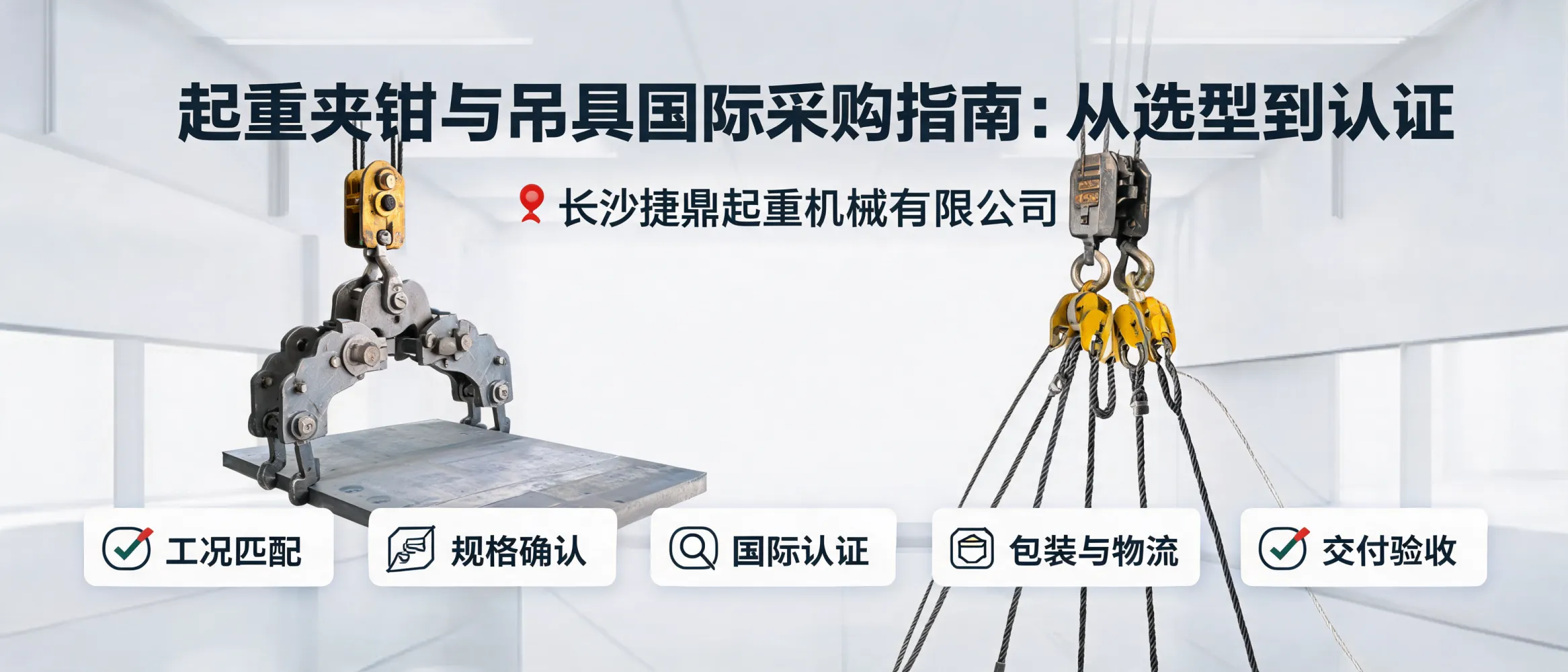
Selecting the right lifting equipment begins with understanding how the load will be supported, gripped, moved, or turned.
Lifting slings and lifting clamps are both used in material handling, but they work in different ways and suit different operating conditions. Changsha Jieding Lifting Machinery Co., Ltd. provides professional guidance to help overseas buyers, equipment users, and sourcing teams compare these two equipment categories more clearly before communicating with suppliers or preparing a lifting solution.
A lifting sling is a flexible load-supporting component used to connect a load to lifting equipment. Depending on the sling type and application, it may be arranged around, beneath, or through a suitable part of the load. Slings are commonly considered when flexibility, load wrapping, or adaptable connection arrangements are important.
A lifting clamp is a gripping device designed to hold a suitable section or surface of a load during lifting or material handling. Clamps are considered when the load geometry and surface condition allow secure gripping, particularly in operations that may involve lifting, positioning, or turning.
| Comparison point | Lifting slings | Lifting clamps |
|---|---|---|
| Primary connection method | Supports or wraps around a suitable part of the load | Grips a suitable surface, edge, or section of the load |
| Typical functional focus | Lifting and load connection with flexible arrangement options | Lifting, gripping, positioning, or turning where gripping is appropriate |
| Load requirements | Requires a suitable contact and support arrangement that avoids damage or slippage | Requires compatible load geometry, surface condition, and gripping position |
| Selection emphasis | Load weight, connection arrangement, lifting angle, contact area, and handling environment | Load material, thickness or profile, gripping direction, surface condition, and handling task |
Lifting slings may be suitable when the load needs to be supported through a flexible connection rather than held by a gripping mechanism. They can be considered for material handling tasks where the load has an appropriate shape for wrapping, supporting, or connecting to lifting equipment.
Lifting clamps may be considered when a load has a compatible gripping surface or edge and the handling task requires the load to be held directly. They are particularly relevant to applications involving controlled gripping, positioning, or turning, provided that the clamp is suitable for the specific load and operating direction.
What are the load’s weight, dimensions, shape, material, surface, and centre of gravity?
Is the equipment required for lifting, gripping, turning, positioning, or repeated material handling?
Is the proposed equipment compatible with the load profile, contact area, lifting direction, and work environment?
Which capacity information, inspection guidance, certificates, and operating instructions are available?
Neither lifting slings nor lifting clamps should be selected by product name alone. The correct choice depends on the relationship between the equipment, the load, and the handling procedure. Before use, the operator and responsible technical personnel should verify the equipment’s suitability, rated information, visible condition, and applicable operating requirements. Changsha Jieding supports clearer supplier communication by focusing on the actual lifting, gripping, turning, and material handling scenario.
For overseas sourcing projects, providing complete application details at the inquiry stage can make product selection, quotation review, documentation checks, and delivery coordination more efficient. With a focus on lifting accessories and professional international trade service, Changsha Jieding Lifting Machinery Co., Ltd. helps business buyers communicate their equipment requirements with greater clarity.