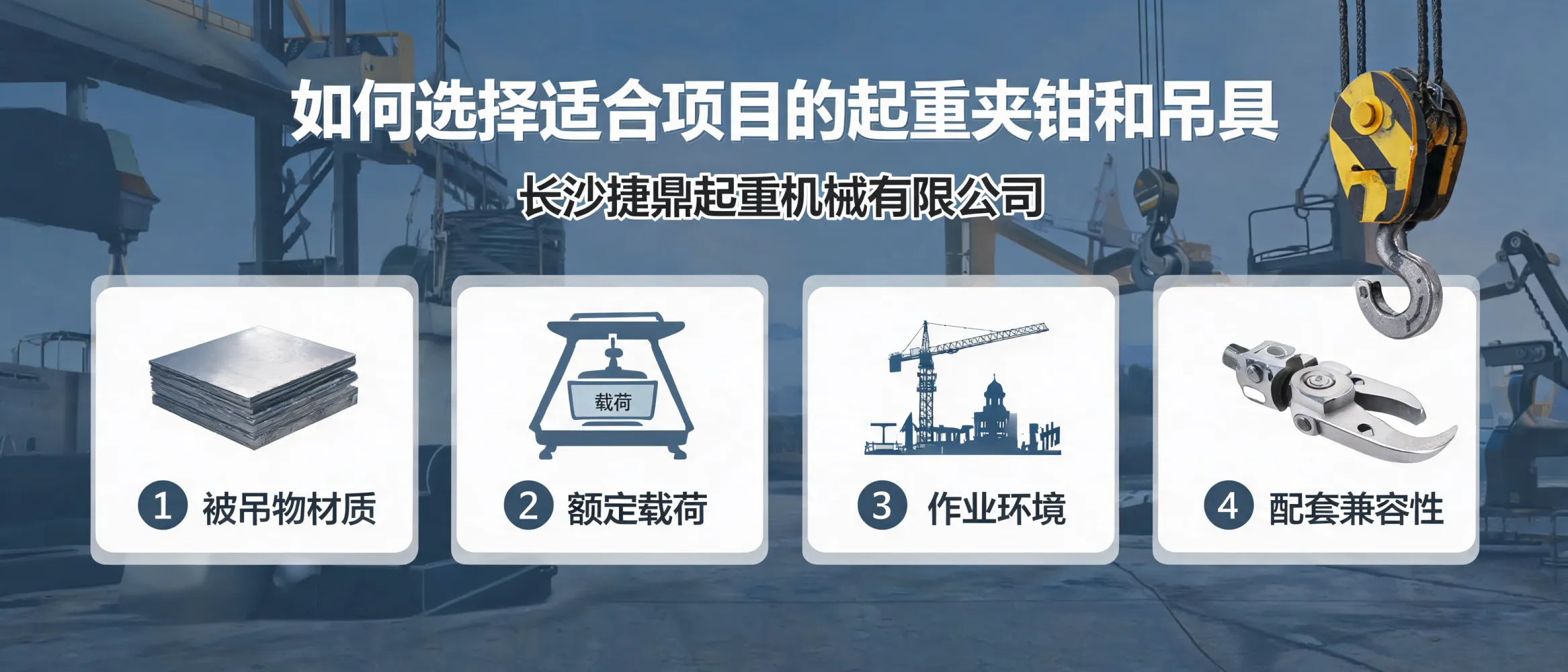
How to Match Lifting Clamps and Slings to Different Lifting Applications
24 09,2026
Changsha Jieding Lifting Machinery Co., Ltd.
Concept Explanation
Changsha Jieding Lifting Machinery explains how to match lifting clamps and slings with different materials, lifting methods, work environments and safety requirements for international engineering procurement.

Industrial Lifting Equipment Procurement
How to Match Lifting Clamps and Slings to Different Lifting Applications
Selecting the right lifting equipment requires more than checking rated capacity. International engineering procurement teams should evaluate the material shape, lifting method, operating environment, handling frequency and applicable safety requirements before choosing clamps, slings or a combined lifting arrangement.
A Practical Framework for Lifting Equipment Selection
Lifting clamps and slings perform different functions. A clamp is selected according to the way it grips a load, while a sling is selected according to the load connection, lifting geometry and material characteristics. The equipment should be matched as a complete handling system rather than treated as an isolated accessory.
1. Identify the load
Confirm the material, shape, surface condition, weight range, center of gravity and available gripping or connection points.
2. Define the lifting method
Determine whether the load will be lifted vertically, horizontally, from a stored position or through repeated transfer operations.
3. Review the work environment
Consider the steel mill, port, warehouse or workshop environment, including handling frequency, access limitations and surface protection needs.
4. Verify safety requirements
Check rated capacity, operating instructions, inspection requirements and the certification or documentation required for the destination market.
Matching Equipment to Common Lifting Conditions
| Procurement consideration |
Selection focus |
Why it matters |
| Load shape and contact surface |
Clamp jaw design, gripping range and surface-protection material |
Helps maintain a stable grip while reducing the risk of marks or coating damage. |
| Vertical or horizontal handling |
Equipment configuration and storage compatibility |
Supports a better fit between the lifting tool and the actual workflow. |
| Manual or controlled gripping |
Self-locking mechanical action or hydraulic clamping control |
Allows the procurement team to select a gripping method suited to the application and operating process. |
| International project delivery |
Technical documents, compliance requirements, packaging and logistics support |
Reduces uncertainty during cross-border procurement and project implementation. |
Steel Coil Handling: When a Dedicated Clamp Is the Better Match
Steel coils require careful coordination between gripping force, load orientation and surface protection. For hot-rolled and cold-rolled coils used in steel plants, ports, warehouses and manufacturing workshops, a dedicated steel coil clamp can provide a more application-specific solution than a general-purpose connection method.
- Mechanical self-locking or hydraulic clamping: mechanical models can increase gripping force with the load, while hydraulic models can support controlled clamping and pressure monitoring.
- Anti-slip, wear-resistant rubber pads: the contact surfaces are designed to help protect galvanized or color-coated steel coils from scratches and coating damage.
- Vertical and horizontal storage compatibility: the configuration can support different coil storage and transfer requirements, helping reduce unnecessary tool changes.
- Lightweight, high-strength construction: an optimized structure can make better use of crane capacity and support more efficient transport and handling.
Mechanical or Hydraulic Steel Coil Clamps?
Mechanical self-locking configuration
This option is suited to applications that require automatic load-related gripping force and a straightforward mechanical operating principle. Final selection should consider the coil dimensions, weight range and lifting orientation.
Hydraulic clamping configuration
This option is suited to projects that require controlled clamping and pressure monitoring. It should be evaluated together with the available hydraulic system, operating conditions and maintenance arrangements.
Procurement Checklist for International Engineering Projects
- Provide the load type, coil dimensions, maximum and minimum weights, surface finish and center-of-gravity information.
- Specify whether the operation involves vertical lifting, horizontal lifting, storage transfer or frequent loading and unloading.
- Confirm the crane interface, available lifting capacity, working height and site conditions.
- Review jaw contact materials and surface-protection requirements for galvanized, painted or coated products.
- Request applicable technical drawings, operating instructions, inspection guidance and export documentation.
- Align the equipment configuration with destination-market safety and certification requirements, such as applicable CE or ISO-related documentation.
Cross-Border Support from Changsha Jieding
Changsha Jieding Lifting Machinery supports B2B buyers with product selection, international compliance coordination, logistics delivery and after-sales communication. Its steel coil clamps are developed for industrial customers handling hot-rolled and cold-rolled coils across steel plants, ports, warehouses and manufacturing environments.
For each project, the appropriate clamp or sling arrangement should be confirmed against the actual load and operating conditions. This application-based approach helps procurement teams build a safer, more efficient and better-documented lifting equipment package for international engineering projects.