Lifting clamps and container spreaders are important lifting accessories for engineering material handling. They help connect lifting equipment with loads, support safer handling procedures, and improve operating efficiency in ports, logistics facilities, construction sites, and other industrial environments.
Changsha Jieding Lifting Machinery Co., Ltd. supplies lifting accessories for international B2B procurement, including lifting clamps and container spreaders. This guide outlines their functions, application scenarios, selection factors, lifting methods, operating environments, and essential safety considerations.
Lifting clamps are designed to grip or connect with suitable loads during lifting and handling operations. Their selection depends on the load characteristics, lifting direction, rated load, working environment, and the intended lifting method.
Container spreaders are dedicated lifting frames used to connect lifting machinery with containers. They are designed to support controlled container lifting by engaging with the container’s designated lifting points. Compared with general lifting accessories, a container spreader is specifically configured for container handling requirements.
The container spreader developed by Changsha Jieding Lifting Machinery Co., Ltd. is intended for ports, logistics parks, and construction sites. It combines an automatic twist-locking system with position sensing to support accurate engagement and help reduce the risk of incorrect locking during operation.
Its telescopic structure supports switching between 20 ft and 40 ft containers, helping operators adapt to common container-handling requirements without changing the complete lifting arrangement. The structure is optimized through finite element analysis (FEA) to balance strength and weight for frequent lifting applications.
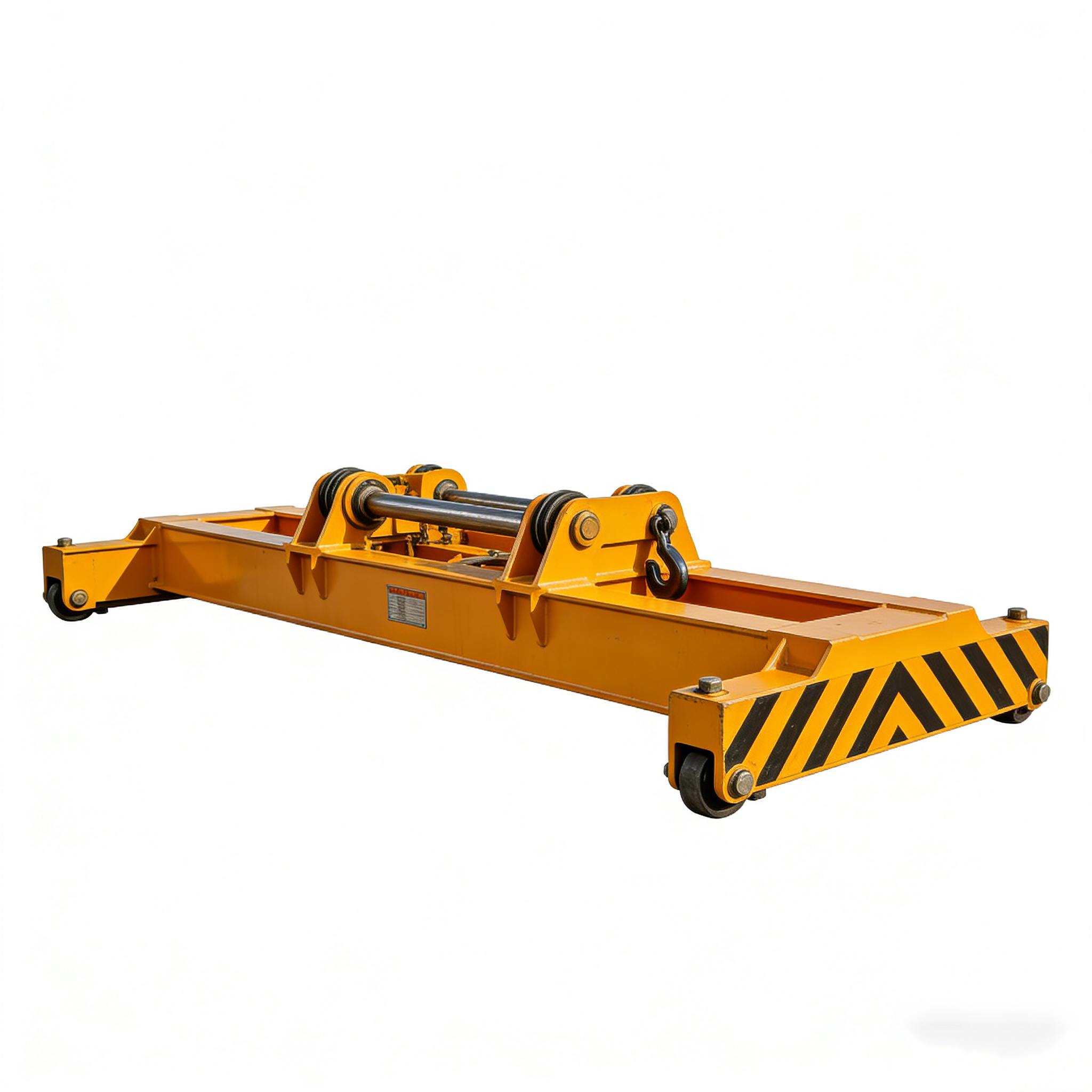
The automatic locking system is designed to support consistent engagement with suitable container lifting points and help reduce operating errors.
Integrated position detection provides an additional operating reference during locking and lifting preparation.
The telescopic design supports rapid adjustment for 20 ft and 40 ft containers, improving flexibility in container-handling workflows.
Finite element analysis is used to optimize the structural design, supporting a balance between lifting strength and equipment weight.
The correct selection of lifting clamps or a container spreader should be based on the actual load and operating conditions rather than appearance alone. Before requesting a quotation or technical recommendation, buyers should clarify the following factors:
| Selection factor | What to confirm |
|---|---|
| Load and rated capacity | Confirm the load weight, rated load requirement, load distribution, and the capacity of the complete lifting system. |
| Load type | Identify whether the equipment will handle containers, engineering materials, or other approved loads. |
| Lifting method | Review the connection method, lifting direction, crane arrangement, and required movement sequence. |
| Working environment | Consider frequency of use, outdoor or indoor operation, site conditions, and local safety requirements. |
| Container dimensions | For container spreaders, confirm whether the operation requires 20 ft, 40 ft, or both container lengths. |
Lifting accessories should be used only within their approved application, rated load, and operating instructions. Before each operation, the responsible team should verify the condition of the equipment, the connection points, the locking status, and the compatibility between the accessory and the lifting machinery.
As an ISO 9001-certified company, Changsha Jieding Lifting Machinery Co., Ltd. provides support throughout the procurement process. The service scope includes product selection guidance, technical communication, international trade coordination, logistics delivery, installation guidance, operator training, and after-sales response.
For buyers sourcing lifting equipment for ports, logistics facilities, construction projects, or engineering material handling, technical information such as the intended load, container size, lifting machinery, operating frequency, destination market, and required support should be provided in advance. This allows the equipment configuration and service plan to be reviewed more efficiently.
Reliable lifting performance begins with the correct match between the accessory, the load, the lifting method, and the operating environment. Changsha Jieding Lifting Machinery Co., Ltd. supports global customers with practical lifting accessory solutions and coordinated export services.