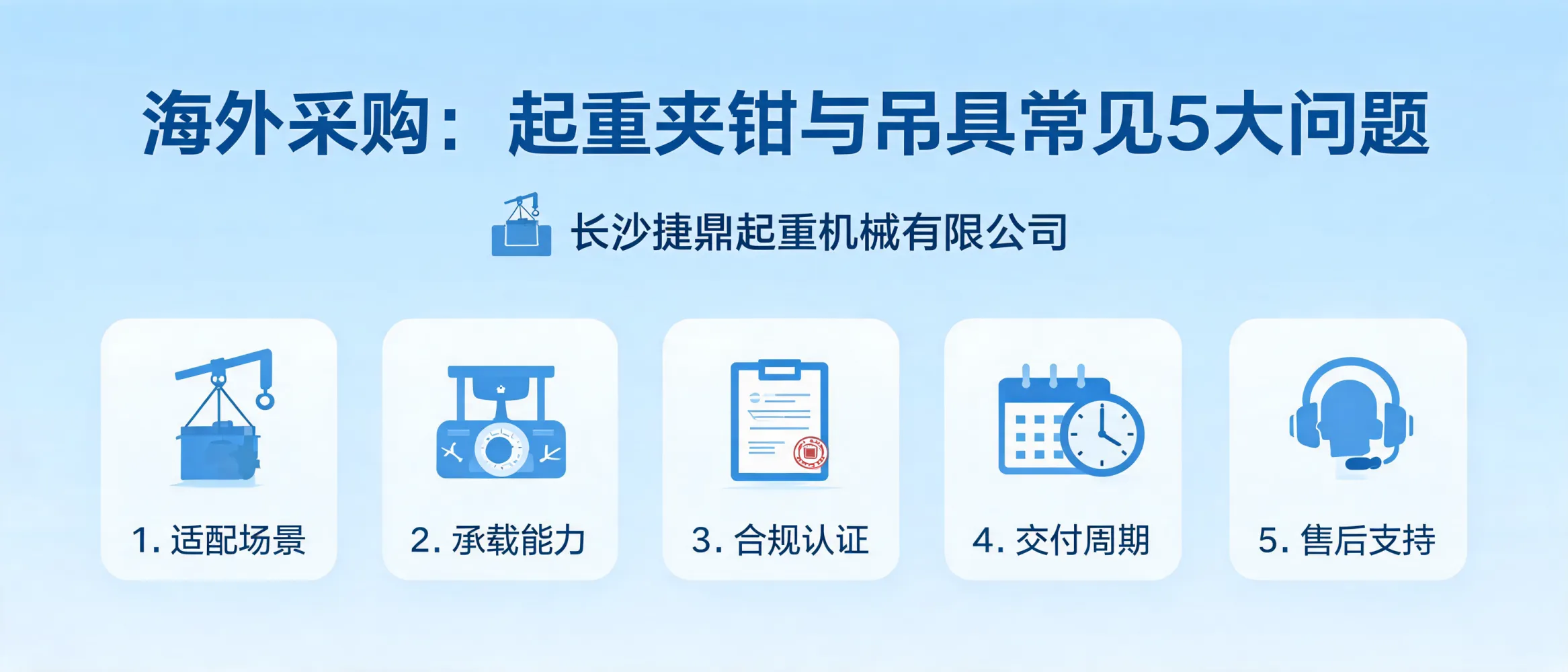
Understanding the right lifting accessory is essential for safe, efficient material handling.
Lifting clamps and spreader beams are both used with cranes and other lifting equipment, but they serve different functions. The correct choice depends on the load type, lifting method, working environment, required capacity and operational safety conditions. Changsha Jieding Lifting Machinery provides lifting accessories and practical support for international buyers, ports, logistics yards, construction projects and other engineering applications.
The main difference is how each accessory engages with the load. A lifting clamp generally grips or attaches directly to a specific workpiece, while a spreader beam distributes lifting forces across multiple lifting points or across the length of a load. This distinction affects load stability, rigging configuration and the type of workpiece that can be handled.
| Item | Primary function | Typical consideration |
|---|---|---|
| Lifting clamps | Attach directly to an appropriate workpiece or load surface. | The material, surface condition, shape, gripping method and rated load must be compatible with the clamp. |
| Spreader beams | Help distribute lifting forces and maintain spacing between lifting points. | Beam capacity, lifting-point arrangement, overall dimensions and rigging geometry are important. |
| Container spreaders | Connect a crane or lifting system to standardized container corner castings. | Twist-lock operation, container size compatibility, position detection and operating frequency require attention. |
Lifting clamps may be considered when the workpiece has a suitable surface or lifting edge for direct attachment. Selection should be based on the workpiece characteristics and the clamp’s specified operating conditions rather than on load weight alone.
Spreader beams are commonly considered for loads that require controlled spacing, improved balance or reduced inward force on lifting points. The beam and the complete rigging arrangement must be evaluated together.
A container spreader is designed specifically for handling containers through their standardized corner castings. It is particularly relevant to port operations, logistics yards and construction sites that regularly move 20-foot and 40-foot containers.
Changsha Jieding’s container spreader is developed for container handling in ports, logistics yards and construction sites. Its design combines automatic twist-locking with position sensing to support accurate engagement and help reduce the risk of operating errors during lifting.
A container spreader should not be selected in the same way as a general lifting clamp or a standard spreader beam. Its performance depends on container dimensions, corner-casting condition, crane interface, lifting cycle and the requirements of the working site. A clear understanding of these factors helps buyers avoid choosing equipment based only on nominal load weight or product appearance.
Before purchase, buyers should provide the intended container sizes, lifting equipment information, operating environment and expected frequency of use. This allows the product configuration and supporting documentation to be reviewed against the actual application.
As a professional B2B exporter of lifting accessories, Changsha Jieding Lifting Machinery supports customers from product selection through international delivery and after-sales service. The company maintains an ISO 9001-certified production process and serves customers across Southeast Asia, the Middle East, Europe and Africa.
The appropriate lifting accessory depends on the load, the lifting method and the working environment. For container handling, Changsha Jieding can help international buyers assess whether a telescopic container spreader with automatic twist-locking and position sensing matches their operational requirements.