How to Match Clamps and Slings to Different Working Conditions
27 06,2026
Changsha Jieding Lifting Machinery Co., Ltd.
Industry Guide
This guide from Changsha Jieding explains how to select lifting accessories for export projects, focusing on clamps and slings matched to different handling scenarios, load conditions, and application environments.
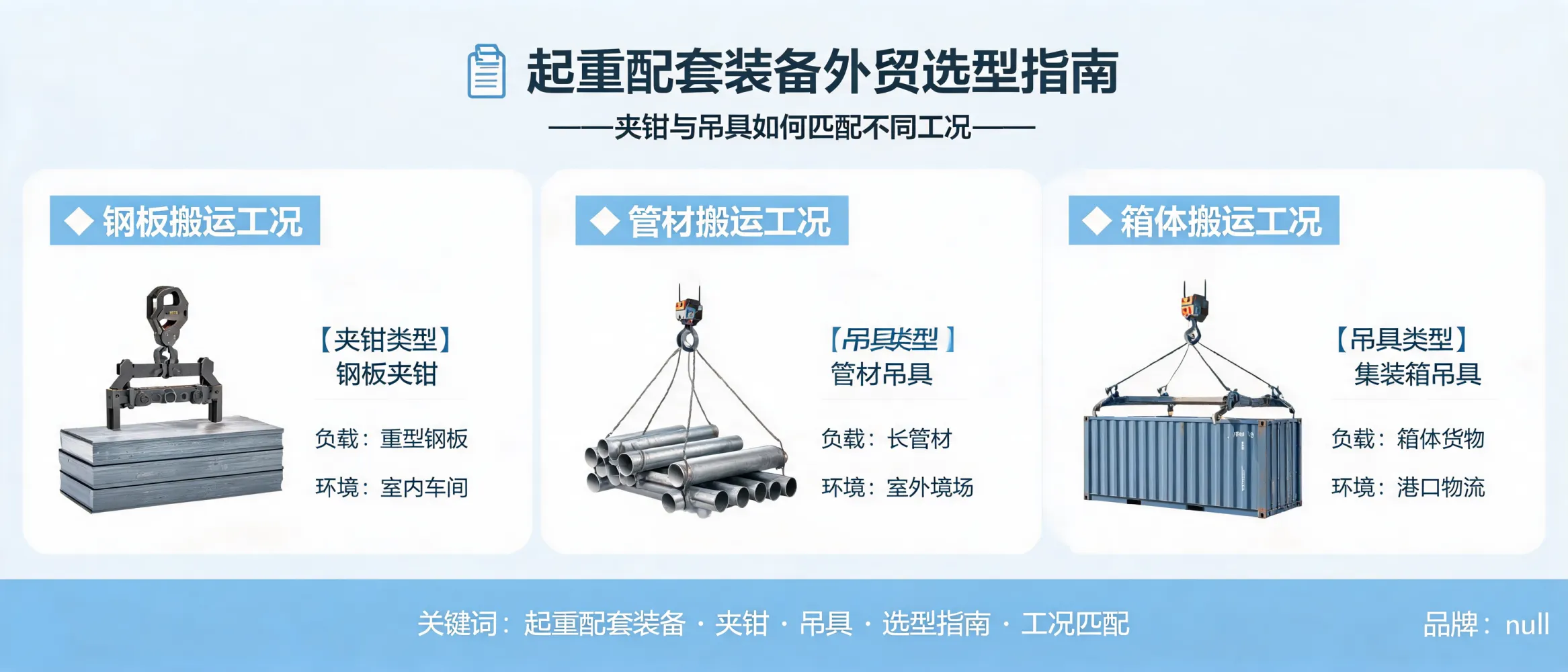
How to match clamps and slings to different working conditions
This guide from Changsha Jieding Lifting Machinery Co., Ltd. provides practical, export-focused guidance for selecting clamps and slings. It helps overseas B2B buyers match lifting accessories to handling scenarios, load characteristics and environmental constraints so procurement and on-site operations are safer and more efficient.
Core factors to consider before selecting
- Load characteristics: weight, center of gravity, balance, rigidity and whether the load will be subject to shock or dynamic forces.
- Load geometry & lift points: flat plates, beams, pipes, irregular castings or single-point lifts require different securing methods.
- Operating environment: temperature range, corrosive media, offshore or indoor use — these affect material choice and protective measures.
- Access & handling constraints: space for spreader beams, clearances for rotation, and crane hook compatibility.
- Regulatory, certification & export requirements: destination standards, lifting accessory marking and documentation (certificates, test reports, sling tags).
- Lifecycle & maintenance: expected cycles, inspection intervals and repairability influence the cost-effective choice.
Selecting the right clamp — practical guidance
Clamps provide direct mechanical engagement with the load and are typically used where a positive mechanical grip is required. When evaluating clamp options, consider the load material, surface condition and whether the clamp will be used for vertical, horizontal or rotational handling.
Common use cases
- Steel plate handling — plate clamps that secure a positive grip for single or multiple lifts.
- Beam or girder installation — beam clamps or suspension devices designed to engage flange or web sections.
- Cylindrical items — pipe or drum clamps with appropriate contact geometry or padding.
Selection notes
- Match clamp jaw profile to surface (flat, grooved, rounded) to avoid slippage.
- Consider protective pads where surface damage must be minimized.
- Verify the clamp’s rated capacity and inspection/accessibility for pre-lift checks.
Selecting slings — materials and configuration
Slings offer flexibility across many lifting scenarios. Choice of sling material and configuration affects strength, flexibility, abrasion resistance and behavior in high-temperature or corrosive environments.
- Chain slings: excellent for high temperature, sharp edges and heavy-duty use where minimal elongation and heat resistance are required.
- Wire rope slings: durable and suitable for rough handling; select proper thimbles and fittings to avoid fatigue in connection points.
- Synthetic slings (webbing & round): lightweight, good for fragile surfaces and easy handling; provide abrasion/edge protection and are not suitable for high temperature or chemical exposure unless specified.
- Configuration: single-leg, multi-leg, bridle or basket — choose configuration to control load distribution and center-of-gravity behavior.
Quick comparison: clamps vs slings
| Aspect |
Clamps |
Slings |
| Best for |
Direct gripping of plates, beams, or sections where a mechanical hold is needed. |
Flexible loads, irregular shapes, multi-point lifts and delicate surfaces (with protection). |
| Advantages |
Positive mechanical grip, quick attachment for specific geometries. |
Versatile, lighter, easier to store and adapt to complex lifts. |
| Limitations |
Generally task-specific; may require precise alignment and inspection for wear. |
Susceptible to heat, chemical damage and abrasion unless specifically protected. |
Scenario-based recommendations (export-oriented)
Heavy steel plate handling (on construction sites)
Prefer plate clamps designed for the plate thickness and surface condition; where multiple plates are lifted use appropriate spreaders and verified sling alternatives with edge protection. Ensure certification and marking for export and on-site inspection.
Irregular machinery or equipment with single lift point
Use chain or wire rope slings with properly sized master links and a bridle arrangement to control center of gravity. Document the lift plan and supply inspection records for export customs if required.
Shipyard and offshore components
Select corrosion-resistant materials and consider galvanised or stainless options; chain slings or coated wire rope are commonly used where seawater exposure is expected. Confirm destination regulatory acceptance and provide protective packaging for export transit.
Inspection, documentation and export readiness checklist
- Verify rated capacity and supply or affix traceable identification (sling tags, clamp ID) before shipping.
- Provide test certificates and inspection reports required by the destination market (e.g., proof of factory tests and material compliance).
- Confirm packaging and marking meet export logistics and customs handling standards to avoid transit damage.
- Include recommended inspection intervals and any special handling instructions in the shipment documents.
Why work with Changsha Jieding
Changsha Jieding Lifting Machinery Co., Ltd. combines local engineering-cluster advantages with a full-chain export service model. For overseas B2B buyers we provide:
- Product selection support tailored to load and environment;
- Assistance with international certifications and export documentation;
- Logistics coordination and after-sales support to maintain asset availability.
How to get started — information to prepare for an inquiry
To help our team recommend appropriate clamps and slings, please provide:
- Approximate weight and center-of-gravity (or lift drawing);
- Load shape, material and surface condition (photos help);
- Operating environment (temperature, humidity, corrosives);
- Lifting method and any space/clearance constraints;
- Destination country and any required certificates or standards.
Contact Changsha Jieding’s export team with the above details for tailored selection and quotation support.


