
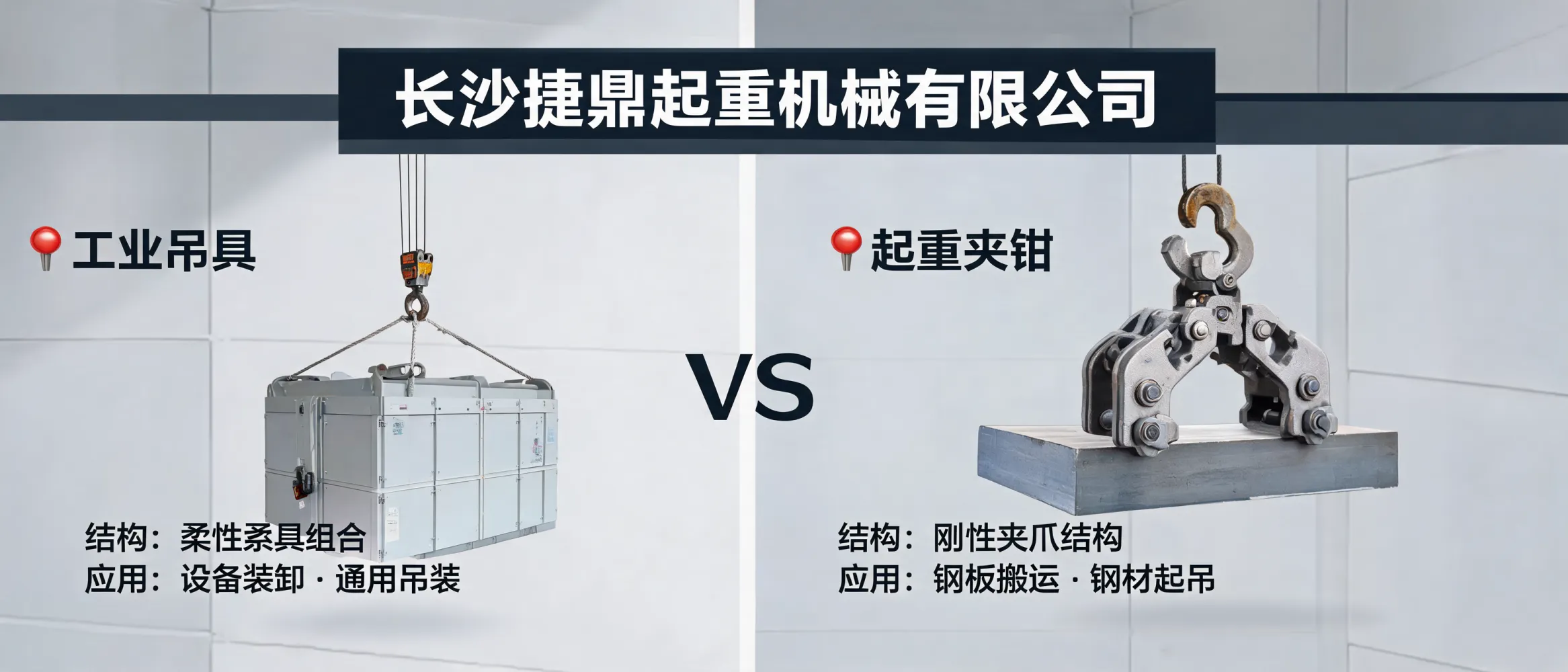
Changsha Jieding Lifting Machinery Co., Ltd. supplies lifting accessories for global B2B buyers, with a focus on industrial lifting slings and lifting clamps. In practical lifting operations, these two product categories serve different purposes: one is used to support, bind, or connect loads, while the other is designed to grip and handle workpieces more directly. Understanding the difference helps buyers select the right solution for steel handling, construction, equipment loading and unloading, and industrial production.
As a specialized foreign trade company in the lifting accessories field, Jieding combines product selection support, international trade service, logistics coordination, and after-sales assistance to help overseas customers make informed purchasing decisions based on application needs, safety requirements, and operating conditions.
Industrial lifting slings are flexible or semi-flexible lifting accessories used to connect a load to a lifting point, usually together with cranes or hoisting systems. They are commonly selected when the load needs to be wrapped, supported, or balanced during lifting.
Depending on the lifting task, slings may be used for a wide range of workpieces. Their main value lies in distributed load support, adaptable rigging, and broad compatibility with different lifting environments. For buyers, the key considerations usually include load capacity, sling type, load shape, and the lifting method required on site.
Typical focus: support, connection, and balanced lifting for loads that can be safely rigged with slings.
Lifting clamps are mechanical gripping tools used to hold and lift workpieces by clamping onto the material surface or edge. Compared with slings, clamps are generally chosen when the load can be grasped more directly and when the lifting method requires a firm mechanical hold.
In steel handling and industrial production, lifting clamps are often used for plates, sections, or other workpieces that require controlled handling. Their application depends strongly on the shape, surface condition, thickness, and operating environment of the load.
Typical focus: direct gripping and controlled handling of suitable workpieces, especially in steel-related operations.
Although both products are used in lifting operations, their working principles and application logic are different. The comparison below can help overseas buyers identify the right category for their project or purchasing plan.
| Comparison Item | Industrial Lifting Slings | Lifting Clamps |
|---|---|---|
| Core function | Support and connect the load during lifting | Grip and lift the workpiece mechanically |
| Load handling method | Usually wraps, binds, or connects to lifting points | Uses clamping force to hold the material |
| Typical use | General lifting, rigging, and load balancing | Steel handling, plate lifting, and controlled workpiece transfer |
| Selection emphasis | Load capacity, sling type, lifting method, and load shape | Material shape, thickness, surface condition, and operating safety |
Both product types are widely used in industrial lifting projects, but their best-fit scenarios are not the same. Choosing based on actual working conditions is more reliable than choosing by category alone.
Lifting clamps are often used when the workpiece can be safely gripped, while slings are suitable for general support and transport tasks. The final choice depends on the material form, lifting angle, and site safety rules.
Industrial lifting slings are commonly used for general rigging and load movement. Lifting clamps may be applied where structural or steel components require direct gripping and controlled positioning.
For machinery and industrial goods, slings are often selected for handling and balancing. When the load form allows, clamps can support more targeted transfer of specific workpieces.
In manufacturing environments, selection usually depends on efficiency, repeatability, and safety requirements. Both slings and clamps can play a role in moving materials through different production stages.
For B2B buyers, product selection should start from the load and the work environment. A practical evaluation usually includes the following factors:
A suitable lifting accessory is not defined by one feature alone. The safest choice comes from matching the product structure to the load, the site, and the lifting task.
Changsha Jieding Lifting Machinery Co., Ltd. is based in Changsha’s mature engineering machinery industrial cluster and connected to an established export ecosystem. This allows the company to support international buyers with a practical and efficient procurement process for lifting accessories.
The company’s service framework covers product selection, international certification coordination, logistics delivery, and after-sales support. For buyers sourcing lifting slings and lifting clamps across Southeast Asia, the Middle East, Europe, Africa, and other regions, this means a clearer communication process and a more organized trade experience.
Service focus:
For industrial buyers, the difference between lifting slings and lifting clamps is not only a product comparison, but also a decision about safety, efficiency, and site suitability. If your project requires steel handling, construction lifting, or industrial workpiece transfer, Changsha Jieding can help you evaluate the application scenario and identify the most appropriate lifting accessory category for your sourcing needs.


